Thursday, July 28, 2022

Is Pickleball a New Way to Stay Fit or Just a Craze?

It’s the latest fad to hit the courts — but will it last?
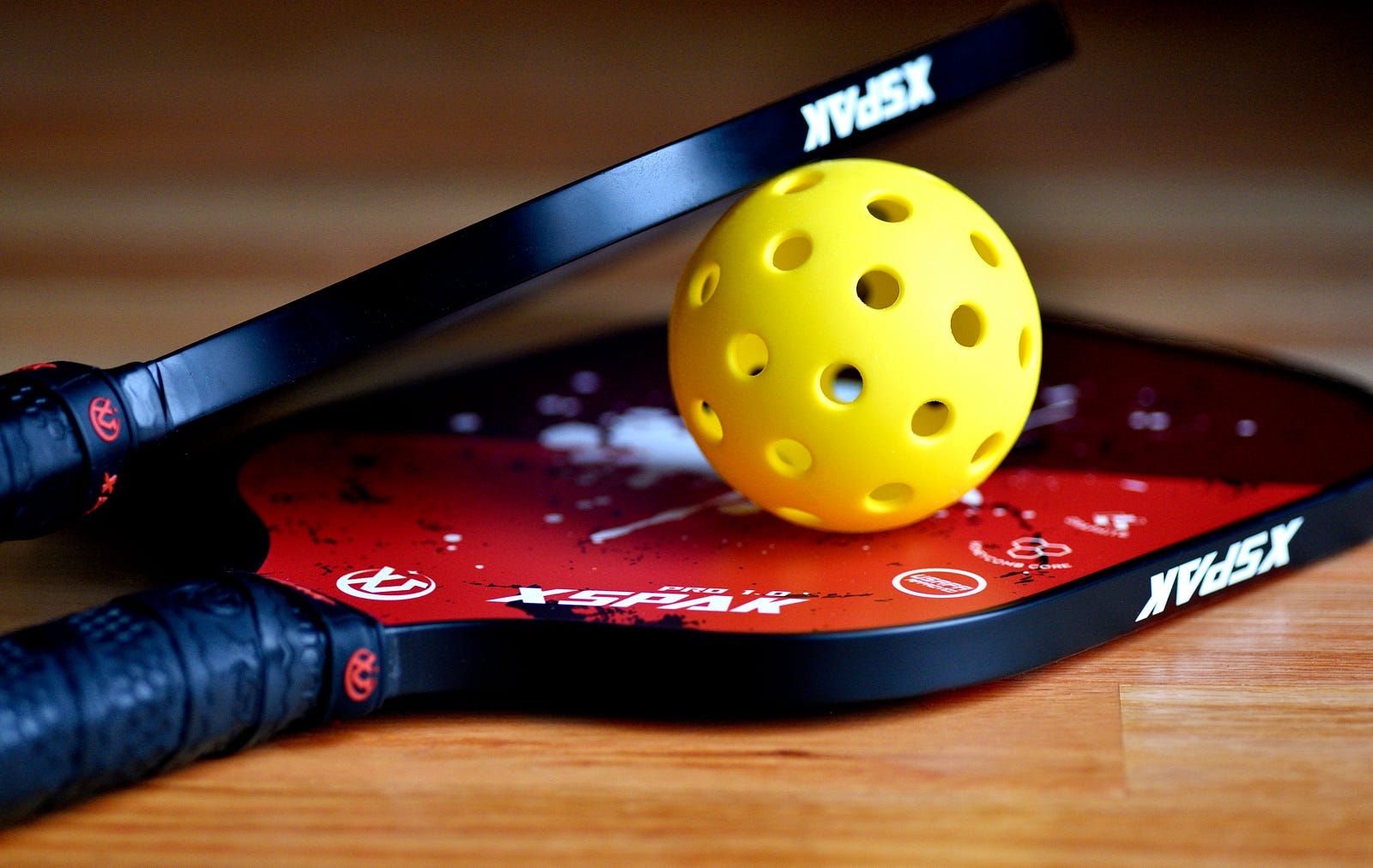
Photo by Ben Hershey on Unsplash

In 2013 I made an acquaintance with a woman married to my husband’s friend.

During dinner, she asked if I played pickleball? What the heck is pickleball?

Carol explained it was a cross between tennis and ping-pong and maybe a bit of badminton thrown in, too.

How the heck did this game come to be, and why the silly name?

The story is that in 1965, three dads tired of hearing their children complain of boredom created this game for them. They loved it.

There are two versions of how the name came about. The wife of one of the men coined the term as the game is a combination of three other sports, referencing the second-string crewing the “pickle boat” in rowing.

Another understanding is that the game was named after one of the creator’s dogs, “Pickles,” as she loved chasing the ball.

Learning

Carol is several years older than me and reported that the game is perfect for older adults as the court is smaller than a tennis court, approximately one-fourth the size, and the game is usually played with doubles.

Clearly, not as strenuous as tennis, yet still enough movement to get quality exercise.

Another six years after first hearing about this game, I ventured out to give it a whirl.

My friend Shannon and I signed up for lessons through the local Park and Rec, and I have never looked back.

Shannon suffered tendonitis the first month of play and decided it wasn’t her favorite sport.

I love the game. It’s challenging, fun, and a great way to develop new neural pathways in the brain. Just try remembering who served last or what the score is! Fortunately, four of us are playing, so between us, we usually come up with the answers.

We also must learn to serve, return the ball and remember the rules — and there are a few.

I started playing late in 2019 and have advanced slowly but steadily in my skill level.

Individuals can take lessons from private coaches, and the cost is reasonable, or many communities offer group lessons.

I am involved in league play — all-women teams are my favorite. Depending on where you live, you can play the game all year.

In Arizona, the winter months from October through April are ideal for outside play. The summer play takes place very early in the mornings or indoors. 

Quite a few gyms have added pickleball courts or marked basketball courts for pickleball play, too.

Nationwide, tennis courts are being converted into pickleball courts — requested by those who live in those communities.

Over 9,500 pickleball courts throughout the U.S. prove this game is here to stay.

Anyone can play

Pickleball is not only for older folks, as it appeared in the beginning. Men and women of all ages are now playing. Many have tennis backgrounds and are transitioning as fewer injuries occur with pickleball. 

Children are getting into the act, too, and some schools have added the game to their Physical Education programs.

Celebrities have also joined in on the craze. Ellen DeGeneres, George Clooney, and his wife, Amal, Matthew Perry from “Friends,” Leonardo DiCaprio, Stephen Colbert, and Brene Brown, author, and speaker, are among the devotees.

                                                            *        *        *

To say pickleball has changed my life is not an overstatement. 

Before learning this game, my exercise activities consisted of hiking the hills, walking my Golden Retriever, taking various exercise classes and yoga at the gym, and a bit of strength training at home. Yes, a considerable amount, though, of course, spread throughout the week.

I still do those, except for the gym classes I eliminated because of Covid. 

Adding pickleball to the mix has significantly improved my fitness level. I play three to five times a week for one and a half to two hours each time.

The best part of pickleball? I have made amazing, kind, supportive friends who have become very dear to me. 

The bottom line — I have not one negative thing to say about pickleball — okay, one — we need more courts! 

Pickleball is a craze — a healthy, fun, exuberant sensation that is here to stay. Give it a try — you’ll love it.

Thursday, July 21, 2022

Can Brad Pitt's Latest Revelation About His Alcohol Addiction Help You?

 Does telling our stories about our addictions help others? —Maybe especially if you're a celebrity.

Photo by Sicong Li on Unsplash

Handsome, talented Brad Pitt was addicted to alcohol just like millions of ordinary people. 

I'm not saying you and I are ordinary in the sense of being average or unremarkable, so don't be offended.

He's a celebrity, and we often put them on a pedestal. Frequently, they fall off the darn thing only to reveal their humanness. 

If they're brave enough, they also are willing to be vulnerable.

Brad Pitt dared to do just that. And not just once. He's given multiple interviews where he admitted he was addicted to the drink.

It took Angelina Jolie filing divorce papers and a drunken altercation on a private jet with his son for him to sober up.

Pain and alcohol

What's up with these celebrities and their addictions, you might ask. They have fame and fortune. Most of them have great looks, often beautiful spouses and adorable children. They have the wherewithal to buy whatever they desire. 

Why do they turn to drugs and alcohol? 

Many of them, Brad Pitt included, are reminders that alcohol addiction does not play favorites. It can impact people from all walks of life, and it does. No one is bulletproof to alcohol's assault.


Pitt has revealed:

"I have always felt very alone in my life…alone growing up as a kid…alone even out here. And it’s really not till recently that I have had a greater embrace of my friends and family."


How many of us can identify with that feeling of loneliness. We can feel alone even when surrounded by many people. Sometimes, being with others and perhaps not feeling as though you fit in exacerbates the feeling of aloneness.

Pitt also said he suffered from depression and was unsure who he was.

 In Hollywood, it is often bandied about that one must be their "authentic self." He recently admitted he didn't know what his authentic self was.

"Out here in California..there’s a lot of talk about ‘being your authentic self’ it would plague me, what does authentic mean? For me it was getting to a place of acknowledging those deep scars that we carry."


We don't know how deeply others suffer — famous or not. No one gets through life without some degree of pain.

Alcohol is a common antidote to that pain. Ultimately, backfiring, as it did for Brad.

The demise of his marriage helped him see the harm his alcohol addiction was causing.

Being vulnerable

Pitt attended Alcoholics Anonymous meetings and participated in a men's only group.

He comments:

"You have all these men sitting around being open and honest in a way I have never heard. It was this safe space where there was little judgment and, therefore, little judgment of yourself."


He also was astonished and pleased that no one in the group sold his stories to the tabloids.

Pitt admitted that it was very freeing and of great value to disclose his ugly side.

Another significant facet for many who seek freedom from the drink is to embrace a friend.

Pitt has credited his buddy and fellow actor, Bradley Cooper, with helping him find sobriety.

Other writers and I on Medium have taken the leap and revealed our tales of alcohol addiction. It wasn't easy the first time I published my account of my addiction. However, it was a huge relief.

I have learned so much from readers' comments to my revelations. I also understood and had compassion when writers were brave to tell their alcohol nightmares, too.

Telling our dark secrets about addiction opens up the portal for others. We reveal our shame, and they may feel they can do the same.

The National Institute of Alcohol Abuse and Alcoholism reports that millions of people wrestle with alcohol problems, but only a tiny fraction seek treatment, as Pitt did.

Brad Pitt’s revelations can help you give up booze. He didn’t say it was easy. He went to AA meetings and sought a therapist and the help of a friend. There is no need to go it alone.

Pitt summarizes his recovery humbly:

"I am those mistakes. For me, every misstep has been a step toward epiphany, understanding, some kind of joy."


If you're still drinking, why not join Brad and those of us who have quit alcohol? Be a part of that tiny fraction who have chosen the world of sobriety.

There is help out there. See your doctor or contact a treatment center, AA or start by Googling "help with alcohol addiction."

Your world and a better life are waiting. 


Thursday, July 14, 2022

Are You Strong Enough to Face Your Difficult Emotions?


We all experienced emotions we'd rather not have — but if you're alive, there's no alternative.

Photo by Lee Chinyama on Unsplash

Fear. Grief. Guilt. Insecurity. And their many cousins — frustration, loneliness, anger, and shame. Oh yes, then there's resentment, spite, and sadness.

Sounds overwhelming, doesn't it. 

Do you tend to run from these feelings? Or stuff them? Resist them, perhaps?

Attempt to drink or drug them away?

In the past, I drank some of these emotions away. Or instead attempted to. Other times shopping for unneeded items felt like a way to escape uncomfortable feelings.

Do you accept your challenging sentiments? Maybe even observe them with curiosity?

Resistance

There's a saying I remember hearing for years, and it speaks the truth:

 What you resist, persists. — Carl Jung, Swiss psychologist.


If you resist your emotions, they will not only persist but may enlarge, drawing energy into the resistance cycle, thus producing more resistance and problems.

Hiding, covering up, or denying your feelings is what resisting means.

I'm sure I've experienced all of the trying emotions I've mentioned at one point or another in my life. I've lived a long life.

What about you? Can you recall enduring these difficult conditions of the heart and mind? I know you have.

                                                            *            *            8

My oldest son, Anthony, died six and a half years ago at age 36 due to complications of ulcerative colitis. 

Pain, anger, confusion, frustration, and grief were all emotions I had to face. Oh, and guilt. 

As mothers, we think there is always something else we could have done. 

Those of you who have lost a beloved know of where I speak.

Anthony was an adventurer, sailor, fisherman, and lobsterman. This beautiful soul also experienced myriad emotions in his short, bold, and brave life. 

                                                            *            *            *

Acceptance

We need to allow these challenging emotions and acknowledge and observe them, not ignore, resist or numb ourselves to them.

Everyone has experienced challenging times. We must get to the other side; the only way is through. I know you've heard that before, and it's because it is a truism.

We need to feel every emotion before we can release it. The pain won't resolve until we turn toward it, not away.

And what happens when you get to the other side? 

You're stronger, more resilient. You learn from your emotions. You emerge forever changed by them.

Some of these emotions will stay with you forever, as in my grief over Anthony's death. A parent doesn't recover from a child's passing. 

We must stay open to what our complex life issues can teach us. We learn to accept it and grow from it.

We miss our beloved departed forever, and that love makes us more compassionate and grateful for every moment. That is, if we allow ourselves to truly feel and integrate the emotion.


Anger, fear, resentment, jealousy — admit you are feeling these emotions. Don't shy away from them or feel ashamed. Face them, and you will become stronger by dealing with them head-on.

 Once you feel them, you will understand them. You will be able to discover the source. Some emotions, such as grief, are clear where they stem from. Others are not so obvious.

You will also develop a strength you didn't know you were capable of having. You will own your power.

All emotions are part of the human experience. They're normal. You are "normal."

Our fears, ignorance, misunderstandings, and insecurities are what bring on the emotions.

Remember, these emotions are the result of our circumstances. Often trauma from childhood or a relationship, illness, or anxiety will cause these emotions to appear.

Your life circumstances will be easier to deal with as you have conquered what may have been holding you back.

I'm not saying this is going to be easy. Many things worth achieving are difficult. 

You have mastered many challenges in your life — you can explore your emotions, question them and ultimately find peace.

Please seek help from a therapist if you find this confrontation is too hard to face alone. 

Thursday, July 7, 2022

Does a Solid Daily Routine Help Creative People Achieve More?


Or would you rather just wing it — do whatever “feels” right?

Photo by Arnel Hasanovic on Unsplash

I love my routine. It helps me feel secure and calm and organized.

In July of 2018, I started The Miracle Morning a book by Hal Elrod, Anna David, and Joe Polish.

There is a variety to choose from such as The Miracle Morning for Entrepreneurs, for Real Estate Agents, one for Parents and Families, Network Marketers, etc.

Since I planned on quitting drinking I bought the one for Addiction Recovery.

I am still following this routine today — a full four years later and I must say it is an effective plan that has allowed me to realize a much more productive day and successful life.

Of course, giving up alcohol several months later, also added to my success. 

This practice is one I would recommend for anyone who wants to achieve improvement in all areas of their life.

The routine is one-hour first thing upon waking dedicated to focusing on positive LIFE SAVERS. 

The SAVERS are Silence, Affirmations, Visualization, (or meditation), Exercise, Reading (uplifting or spiritual works — whatever inspires you), and finally Scribing (or journaling). I have found it is a perfect start to the day.

Find the volume that appeals to you for your specific field of interest and learn how it can change your morning. 

Now that we’ve looked at the morning, it’s time for the rest of your day.

One routine doesn’t work for everyone

Now for the contradiction concerning routines. The Miracle Morning routine is a wonderful one for most — albeit not everyone. 

The good news is that this routine can be adjusted depending on your idiosyncrasies. 

If you’re not an early riser but rather a night owl, move the SAVERS to the evening.

What is crucial is that we implement a daily routine and stay with it. Our minds and bodies — e.g. muscle (or mind/body) memory — will fall into a rhythm if we repeat it every day.

If you love rising early — great. 

Is that when you are in your best mood or imaginative space? Or when time is available to you to write, paint or sculpt or do whatever is your creative activity? 

After my morning routine, I typically take my Golden Retriever, Merlin, out for a jaunt, returning home to a few cups of coffee and a light breakfast. 

Often, a few games of pickleball take place several mornings a week.

Daily chores are next and soon time for lunch. 

Finally, I get to create. Right now I’m focusing most of my efforts on writing for Medium. 

Occasionally, I will take the time to design and create a collage. It’s a much different artistic process than writing — yet a challenging exercise for my brain.

Many consider mid-afternoon as a vacant brain time.

Not me. Afternoons, beginning between 1 and 2, is the time my mind conjures ideas of which to write. 

It also helps to have a few inspirations jotted down ahead of time to loosen the juices.

I will be at my computer for the next few hours until the time arrives to begin preparing dinner. (Hubby gets hungry.)

By this time I have usually completed an article, including a photo, title, and subtitle and I’m ready to hit “publish”.

This is a very satisfying day for me.

Lists

A part of my routine are lists. As I mentioned I prefer having a few ideas for articles at the ready before I settle down to write.

I also rely on a weekly to-do list. This contains items I MUST do, those I SHOULD do, and those I WANT to do.

My list helps keeps my thoughts and needed actions organized. 

Each category contains at least three items to be completed. I love crossing them off as I finish each. So satisfying.

At the top of the page is what I consider to be my most important goal for the week. For example; this week's primary goal was to do something for me. 

I buy pre-printed pads that have the categories (Must do, etc.)listed for easy access. They are available online from the Living Well Shop. 

What about “you time?”

I was spending time in California, with my son, Nick and we decided we hadn’t visited a museum in months. Nick chose the Oakland Museum of California. There was a specific exhibit he wanted to view. It was the story of Edith Heath, the founder and creative mind behind Heath Ceramics in Sausalito. Fascinating. 

I’m so glad he chose that museum even though I didn’t know I would be interested in that exhibit. 

Edith was an inspirational individual — way ahead of her time.

 I am motivated to be more creative and look for other artistic outlets to explore after seeing her story.

Taking time for oneself is critical self-care, stimulating your mind, and satisfying your curiosity. Plus, nothing beats learning something new and interesting. 

You never know what may spring from an outing. It’s imperative to stretch and grow and with a routine in place daily, you will have more opportunities to find pockets of time to investigate new areas of interest.

                                                            *    *    *

By the end of the week, I easily see what I’ve accomplished and what still needs to be achieved. The left-over tasks are moved to a new list that will be prepared Sunday evening. 

My routine helps me feel efficient and effective.

Do you have a routine that streamlines your day? Do you make lists? Do you find it helpful to have either?

Some people may feel stifled with a routine. They are more easygoing and carefree than me. This is fine, of course.

We need to know ourselves, what works for us and how we are most successful and happy.


Thursday, June 30, 2022

Dementia Symptoms With a UTI Seems Odd? — It's Not Unusual at All


Photo by Ozan Safak on Unsplash

Thursday, June 23, 2022

The Omicron Wave Was Deadlier Than Delta for Older People

 The dreaded virus keeps morphing and just won’t quit.

Photo by Mufid Majnun on Unsplash

The above title grabbed my attention in The New York Times. I had to find out what was going on.

Alpha, Beta, Delta, and Omicron — are all variants of the Covid-19 virus. What could be next?

SARS-CoV-2, the virus that causes COVID-19, is constantly changing. New variants are an expected part of the virus's evolution, according to Yalemedicine.org. They add that "monitoring each one that surfaces is essential in ensuring the U.S. and globally are prepared."

Omicron is more transmissible than Delta was. However, Omicron is less severe. Yet, more data is needed to assess this variant's potential to cause severe illness, hospitalization, and death.

I don’t usually write about current happenings, yet Covid has been the exception. I first wrote about it in my article; A ‘Very, Very Contagious’ Coronavirus Subvariant Is Causing Cases to Rise Again, published on Medium on May 6, 2022.

Covid and me

I was holding out for the second booster as the information I gathered was that it may not be effective if another variant appeared. It could weaken our immunity to fight it off. Now, I wonder if this information was valid.

I had a fever of 99–101, for three days, with chest congestion and coughing. It has taken three weeks to feel the chest congestion ebbing and cough, too.

I am a robust, active senior who eats a healthy diet and exercises daily. I suspect this helped me have relatively minor symptoms.

Omicron symptoms were mild for most

While overall per capita Covid death rates have fallen, older people account for a greater share.

According to Andrew Stokes, an assistant professor in global health at Boston University who studies age patterns of Covid deaths: "This is not simply a pandemic of the unvaccinated. There's still exceptionally high risk among older adults, even those with primary vaccine series."

Due to this increase in deaths in those 65 and older, from Omicron, we are now strongly encouraged to get the second booster. Regardless of the information, that it could weaken our immunity should a new variant appear? It does get confusing.

Had I had the second booster, would I not have gotten Covid?

"I think we are going to see the death rates rising. It is going to become more and more risky for older adults as their immunity wanes," according to Dr. Sharon Inouye, a geriatrician and a professor of medicine at Harvard Medical School.

There you have it — the second booster is recommended.

We need to keep our immunity strong — at any age, but especially for the over 65 age bracket.

Anti-Covid pill as Omicron surges

However, health officials are letting physicians know that they no longer need to restrict prescriptions to the highest-risk patients. Your symptoms do not have to be severe.

I asked my doctor today (I am recovered for four weeks) what her thoughts are about Paxlovid. She doesn’t advise taking it. Apparently, it lessens your symptoms the first few days but when one has finished the prescribed amount, symptoms may return.

It’s a conundrum — should we or should we not take Paxlovid? Everyone should always check with their health care professional for their opinion. The choice is always yours.

Masking up is always wise as you may be asymptomatic and unknowingly pass the virus on to unsuspecting people.

We must stay vigilant to stay safe.

Thursday, June 16, 2022

Do You Know It's Important to Stay Present?— My LOL Moment

 We may try, yet sometimes it works out for the best if we don’t.

Photo by Valentin Lacoste on Unsplash

The older I get, the more important I know it is to stay in the present moment. Once you arrive into the Third Third of your life, every day is vital, not to be squandered.

In one of my many spiritual books, I recall reading that the best and easiest place to stay present is in the shower. 

We are trapped for several minutes without many distractions. Except for the mind, that is.

Keeping our minds in the shower

Every day I do my best to feel the water as it courses over my body. To luxuriate in the lather of my shampoo and the smooth silkiness of my hair condition.

About 20 seconds into it, I'm thinking about what is next on my agenda. Or should we barbeque chicken for dinner or maybe take-out?

Bringing myself back to the shower — I take in the aroma of the special soap I treat myself to. The package of my current bar, Garnet Grapefruit & Lily, tells me: "They're not just a cleanser, but a sensory experience to be savored daily."

Savored, really? I'm glad it gets me clean, and yes, I do enjoy the scent and the feel but never have I savored it. Gee, I guess I'm missing out.

Next up, let's give the legs a little shave, and what happens to my mind? It begins with thinking about what I will write about today on Medium.com.

That's a sure way to nick me with the razor.

But, wait. What am I doing? Writing about trying to stay present in the shower — so it's not all bad. Thinking about what to write gave me a topic to write about.

I got a chuckle out of that! Who knew I'd have my article for the day while in the shower. Gotta love that.

Staying present has been a hot topic for me personally

This topic — staying in the present isn't new to me, and I have written about it at least twice on Medium. You may want to check out Can You Enjoy Every Moment of Your Life Just as It Is Now?, published May 22, 2022, and This Moment in Time Will Not Be Repeated — Pay Attention to It Now, published April 22, 2022.

You can see, both articles were published within the past two months. Clearly, I am focusing on working on staying in the present. Working on are the operative words.

 Success? Not so much, but that isn't the point. The point is to bring ourselves back to the present moment as soon and as often as we can. And not to judge our success or failure.

When we notice ourselves drifting into thoughts rather than being here and now — shift back.

Maybe I'm easily distracted. Perhaps it's ADD. I'm not being disrespectful to those who deal with ADD or ADHD — it is a possibility that could be an issue for me. And you?

Do you find your mind wandering when attempting to stay on track with a project?

Do we have too much on our proverbial plates?

Maybe. If we do, then let's figure out how to unload them. 

Maybe delegate more to family members? Hire someone? Use all the conveniences that have popped up during Covid for meal prep or delivery?

Yet bringing yourself back to the moment as often as it takes is how to take care of the present.

My distractions worked out well this time

Back to my shower — I got clean, hair washed, and conditioned, and wrote this story in my head in about 10 minutes.

I'm usually not so lucky. Articles tend to take more time and maybe research, but this one was born perfectly. 

Even though I didn't pay attention to every second of my shower, I accomplished more in that 10 minutes than I'd planned.

Let's slow down and take it one moment at a time. We never know if we'll be here for the next blessed beat of our hearts.

Thursday, June 9, 2022

Do You Feel Safe From COVID Exercising In Your Gym Right Now?

Hardworking exercisers are expelling an alarming amount of spittle.

Photo by Inspired Horizons Digital Marketing on Unsplash

Two years ago, many gyms closed temporarily when Covid spread and became a pandemic.

The gym I regularly attended stayed open but instituted several changes they believed made it safer for members.

They separated the equipment by putting several feet between them. An employee was assigned the task of wiping down all equipment continually.

The classes were limited to the number of participants so that at least six feet were between each exerciser. To get into the class, one had to register online. It was a battle to get a spot — first come, first served.

I decided not to go at all. Six feet with a dozen other sweating, panting people didn't feel safe.

Some gyms opted to move the equipment outdoors if there was space. This worked well until the temperatures rose in the summer months.

My choice was to lift weights at home, hike the trails, walk through the neighborhoods and play pickleball outdoors.

Now that the rules have been relaxed and most Americans have received vaccines, gyms are open, and most are operating at full capacity.

I know my gym is back to pre-Covid day rules. Classes are full, no longer requiring six feet, and the equipment is lined up closely.

I'm not participating in any of it.

I'm still maintaining my exercise routine as it was during the high time of Covid, with one exception. When the temperature is sizzling — playing pickleball at an indoor court with three others I know well.

Still, I got Covid. I haven't any idea where or from whom. That said, we can't be too careful.

Omicron is spreading like crazy; infections are up, but, fortunately, symptoms are mild.

Is it safe to return to the gym?

A small study about respiration and exercise published in the Proceedings of the National Academy of Sciences provides frightening answers.

According to the New York Times, the study checked the number of aerosol particles 16 people exhaled at rest and during workouts.

These tiny bits of airborne matter — measuring barely a few hundred micrometers in diameter, or about the width of a strand of hair, and suspended in mist from our lungs — can transmit coronavirus if someone is infected, ferrying the virus lightly through the air from one pair of lungs to another.

The study found that, at rest, the men and women breathed out about 500 particles per minute., But when they exercised, that total soared 132-fold, topping out above 76,000 particles per minute, on average, during the most strenuous exertion.

People are working out to have a trim, muscular and healthy body. Instead, they are inhaling and sharing with their fellow exercisers over 3,800,000 bits of possible Omicron laded aerosol particles per a typical 50-minute class— per person.

There have been several reports of classes where Covid was spread by an infected instructor.

In South Korea, following a Zumba class, 54 attendees developed Covid and then passed it on to their families. All ten members of a spin class in Hawaii became infected by their instructor, as did another 11 who came in contact with one of the infected class members, who taught kickboxing and is a personal trainer.

There have been extensive super-spreader events at gyms since 2020.

Scientists speculate that the exercisers' high respiration rates and inadequate ventilation contributed to this crazily rapid spread of Covid.

"Good ventilation and air exchange are a great way to reduce transmission risk. Open windows, especially with fans, can often be as effective as active ventilation systems," said Dr. Chris Cappa, a civil and environmental engineering professor at the University of California, Davis.

Installing in-room air filters in each workout area is ideal. Dr. Cappa adds, "These can be really effective in reducing transmission risk by removing the virus from the air."

Meanwhile, I'll continue with my outdoor exercise routine until it's safe to go back to the gym.

Thanksgiving

I wish my readers a happy and blessed Thanksgiving Day. I am so grateful for the four years I have been writing and you have been gracious e...